
Modern search is shifting toward AI-driven answers. Generative Engine Optimization (GEO) means optimizing your content so it appears in those AI-generated results (from Google’s SGE to ChatGPT and other LLMs). In practice, GEO is an extension of traditional SEO, focusing on human‑like AI responses. As Salesforce explains, AI for SEO uses machine learning to analyze vast data and improve content relevance in innovative ways. In other words, GEO ensures your content not only ranks in search results but is also chosen by AI “answer engines” when users ask questions. This guide explains why GEO matters now and how to adapt your strategy.
What Is Generative Engine Optimization?
Generative Engine Optimization (GEO) is the process of optimizing web content for AI-powered search engines and large language models. In practice, this means creating content that AI tools (like ChatGPT, Google’s AI Overviews, Bard, Perplexity, etc.) can use to generate answers. Unlike traditional SEO – which targets keyword ranking in lists of search results – GEO targets appearing in the answer itself. For example, an AI answer might quote or summarize your content directly. Backlinko defines GEO as optimizing content so it “appears in AI-generated answers on platforms” like Google AI Overviews or ChatGPT. Importantly, GEO is not a replacement for SEO, but rather an evolution of it: it builds on SEO fundamentals while addressing new AI behaviors.
GEO vs Traditional SEO
Although GEO and SEO share goals of visibility, there are key differences in approach:
- Focus of Optimization: Traditional SEO optimizes content (and backlinks, metadata, etc.) to rank web pages in search results. GEO focuses on optimizing content so AI can use it in responses. In GEO, user queries are answered directly rather than just listed.
- Content Presentation: With SEO, users click through to your page; with GEO, users get an instant answer or summary that may cite your content. For example, Mangools notes that while SEO ranks pages by keywords, GEO is about making content “appear in AI-generated responses” on tools like ChatGPT.
- User Interaction: SEO assumes a user will read your page for answers. GEO assumes the AI will parse your content and present an answer directly. In essence, GEO “shapes the conversation” rather than just vying for the top SERP position.
- Metric of Success: SEO success is traditionally measured by rankings, clicks, and conversions. GEO success is measured by how often AI tools reference or use your content in their answers. For instance, Mangools points out that instead of “traffic and conversion”, GEO performance is tracked by “how often content is used or referenced by AI-generated results”.
In short, SEO is about being found in search; GEO is about being chosen by AI to answer a query. However, good SEO still underpins GEO: if your content is high-quality and accessible, it stands a better chance of showing up in both search results and AI answers.
Why GEO Matters Today
AI-powered search is growing rapidly. Google’s launch of the Search Generative Experience (SGE) and the explosive adoption of ChatGPT have changed how people seek information. Backlinko reports that chatbots and AI assistants now drive billions of search impressions – in some forecasts, by 2027 LLM-based search could overtake traditional Google search traffic. Indeed, Backlinko’s data shows an 800% year-over-year jump in referrals from LLMs in recent months. As a result, if your content isn’t optimized for these AI platforms, your brand risks losing visibility as users increasingly rely on AI answers.
GEO helps future-proof your content. By optimizing for AI search:
- Expanded Reach: Your content can be discovered in new ways (voice assistants, AI chatbots, smart devices, etc.) beyond the classic web browser.
- First-Mover Advantage: Right now, not all competitors are focusing on GEO. Adopting GEO strategies early can give your site a head start in AI-driven search results.
- Improved Engagement: Many GEO best practices (like clear answers and conversational content) also improve user experience and traditional SEO. In fact, HubSpot notes that the best GEO practices – such as using easy-to-read language and focusing on user intent – aren’t much different from SEO best practices.
In summary, GEO matters because search is evolving. Brands that adapt by optimizing for AI answers will capture more of tomorrow’s search traffic, while those that rely solely on old SEO techniques may fall behind.
Core Principles of GEO
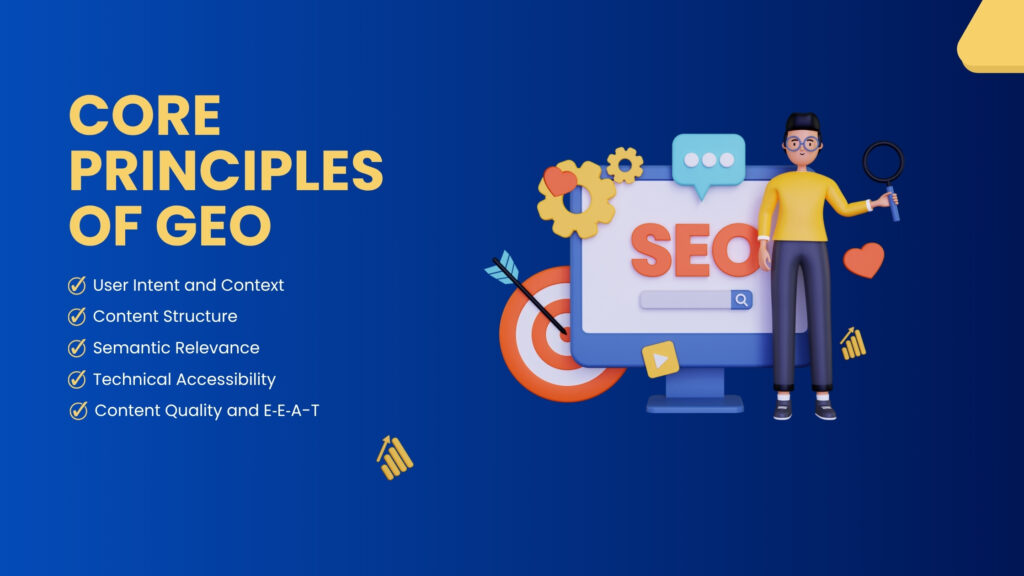
GEO rests on several key principles that extend traditional SEO:
- User Intent and Context: GEO prioritizes understanding why people ask a question. Rather than just matching keywords, you must provide comprehensive, relevant answers. For example, AIOSEO advises focusing on context and intent instead of keyword stuffing. This means your content should directly address user questions in plain language, matching the conversational style used in AI prompts.
- Content Quality and E‑E‑A-T: High quality content is non-negotiable. Because AI models rank information by trustworthiness, your content must demonstrate Expertise, Experience, Authoritativeness, and Trustworthiness (E‑E‑A‑T). HubSpot and others emphasize writing content that showcases your expertise and fully covers a topic. AI search engines favor thorough, factual answers from credible sources.
- Technical Accessibility: GEO requires that AI “readers” (web crawlers or API fetches) can find and understand your content. This means using clear HTML structure, sitemaps, and schema markup. For example, Backlinko suggests ensuring “technical accessibility so AI crawlers can easily access and understand your content”. Structured data (like FAQ or product schema) can also help AI parse your content.
- Semantic Relevance: Use related terms and NLP-friendly language. AI search uses natural language processing, so integrate synonyms and semantically related keywords naturally. The HubSpot guide explicitly recommends using conversational language and including related terms to help NLP understand your content.
- Content Structure: Organize content clearly with headings, lists, and visuals. This not only helps human readers but also aids AI summarization. (We discuss readability more below.) Google’s John Mueller notes that while readability isn’t a direct ranking factor, “if you write content that’s hard to understand, then it’s going to be harder for people to stay and read,” which can hurt SEO indirectly. So GEO demands a content structure that supports easy comprehension.
These principles align closely with good SEO: understand intent, produce high-quality answers, and make content crawlable. In fact, as Backlinko notes, “GEO builds on the foundation of great SEO”, meaning if you’re already creating valuable, accessible content, you’re partway there.
Key GEO Strategies and Best Practices
To apply GEO, follow these practical steps:
- Optimize for Conversational Queries: Identify the questions your audience will ask an AI. Use tools (e.g. People Also Ask, keyword planners) to find conversational, long-tail queries. HubSpot’s expert recommends phrasing content to match those queries, as generative engines favor natural language questions. For instance, instead of only targeting “best running shoes”, include phrases like “what are the best running shoes for beginners?”.
- Perform Keyword Clustering: Even in GEO, keyword research is still useful. Find relevant keywords and group them into topic clusters. Cover each cluster thoroughly on the page. One case study shows SEO success by using a focus keyword plus related long-tail terms, then writing an in-depth article using SEO best practices. This ensures AI has rich content to draw from.
- Create Authoritative, In-Depth Content: Write detailed answers that leave few gaps. AIOSEO suggests focusing less on keyword stuffing and more on providing meaningful, relevant answers to user queries. Include statistics, examples, and expert insights to boost E‑E‑A‑T. HubSpot advises covering topics in full and letting content flow naturally rather than forcing every keyword.
- Use Structured Markup and FAQs: Help AI and search engines by adding structured data. FAQ schema, Q&A markup, and clear headings signal to bots which content answers which questions. If you have a FAQ section (as we do here), tag it properly – AI engines often use these in answers. Also consider featured snippets or answer blocks in your markup.
- Leverage Multimedia: Include relevant images, charts, or videos with your answers. AI models may use alt text or image data, and visuals engage users. HubSpot highlights that being visual within your content (infographics, graphs, videos) helps engagement and gives AI more context. Make sure images have descriptive alt text for accessibility.
- Monitor Brand Presence: GEO success isn’t just on your website. AI search pulls from across the web. Manage your brand’s narrative online. According to HubSpot, generative engines “pull information directly from web content” about your brand. Encourage positive mentions on reputable sites and optimize all profiles. Use tools like HubSpot’s AI Search Grader to track where your brand shows up in AI search.
- Adapt Technical SEO: Ensure your site can be crawled by bots (allow crawling of key pages), and that content isn’t hidden behind logins or scripts. Many AI search results still rely on Google’s index, so retain solid on-page SEO (fast pages, mobile-friendly design, etc.).
- Utilize AI Tools Wisely: There are now AI-powered SEO tools that help with GEO. For example, keyword research tools using NLP can suggest question-based queries. Content generation tools can draft outlines or first drafts of SEO-friendly content. But always review AI-generated content for accuracy and voice.
By combining these tactics, your content will be structured to satisfy both human readers and AI answer engines. If you prefer expert guidance to implement these strategies at scale, consider exploring professional SEO services that can handle technical audits, content optimization, and ongoing management. Remember, many GEO tactics are actually just best practices for useful content. As Backlinko points out, if you’ve invested in SEO fundamentals (good content, accessibility, authority), you’re already well on your way with GEO.
AI Tools and Technology in GEO
The technology landscape behind GEO is evolving. Large language models (LLMs) like OpenAI’s ChatGPT or Google’s PaLM power AI search. Meanwhile, specialized SEO tools are adding AI features. For example, Contently’s 2025 report highlights that modern AI SEO tools now include semantic analysis, predictive insights, and real-time optimization suggestions. These tools offer several advantages:
- Advanced Keyword Analysis: AI-driven tools scan massive datasets to find valuable keywords and uncover their deeper meaning. As Contently notes, AI can “scour through mountains of data” to pinpoint the best keyword opportunities and related terms.
- Enhanced Content Relevance: By analyzing user behavior and search intent, AI helps tailor content more effectively. Contently explains that AI tools observe how audiences engage and then suggest content that “rings true with your audience”.
- Automation & Efficiency: Routine SEO tasks can be automated. AI tools can auto-generate meta tags, summarize content gaps, or even draft outlines, freeing marketers to focus on strategy.
- Data-Driven Decisions: Real-time analytics and SERP monitoring built into AI SEO platforms enable quick tweaks. Contently highlights that AI provides “real-time analytics [and] smart decision-making” to up your SEO game.
- Scale and Consistency: For large sites, AI ensures consistent optimization across many pages. Modern tools integrate with CMS and maintain brand voice at scale.
In practice, you don’t need every tool – but consider leveraging AI where it helps. For example, use AI content graders to check readability and keyword usage, or AI writing assistants to brainstorm outlines. Also, pay attention to platforms like Google’s Search Generative Experience and Microsoft’s AI integrations; optimizing for these may involve specific tactics like creating FAQ-rich pages or featured snippet content.
Improving Content Readability and Structure
A critical piece of GEO (and SEO) is readability. If your content is hard to read, users (and AI models) may ignore it. As one expert puts it, “content readability impacts user experience, and user experience is a signal Google cares about”. In practice, aim for clear, concise writing at about a 7th–9th grade level.
Here are some key readability practices to follow:
- Keep paragraphs very short (around 2–4 sentences) and sentences under ~20 words. This prevents walls of text that readers (and AI) skip.
- Use simple, familiar words and an active voice. Avoid jargon when possible. Google’s guidelines suggest matching the reading level to your audience.
- Break up text with headings and subheadings (one every ~300 words) to create digestible sections. Each section should cover a single idea.
- Use bullet points or numbered lists for clarity and scannability. AI models and humans both appreciate structured lists for key points.
- Highlight key ideas in bold or italics sparingly, to guide attention. Visual emphasis can also help AI identify important concepts.
- Incorporate images and visuals with descriptive alt text. Visual content not only engages readers but also gives AI additional context.
These guidelines match normal SEO best practices. In fact, HubSpot’s infographic above shows that writing in “short, focused paragraphs”, using clean fonts, bullet points, and conversational tone all make content more SEO-readable【9†】. By structuring content this way, you increase dwell time and reduce bounce rate, sending positive engagement signals to search engines.
Conclusion
Generative Engine Optimization is an emerging but essential evolution of SEO. To succeed, focus on your audience’s questions: write clear, authoritative content that directly answers those questions, and structure it for easy parsing by both humans and AI. Many GEO tactics reinforce best practices in traditional SEO – so optimizing for generative search will also help your site’s overall visibility. As AI continues to shape how people find information, adapting your strategy with GEO means your content remains discoverable on all fronts.